
By Tom Joyce
Every few years, the same argument gets recycled, repackaged, and sold as if it were new. It is
definitely not new.
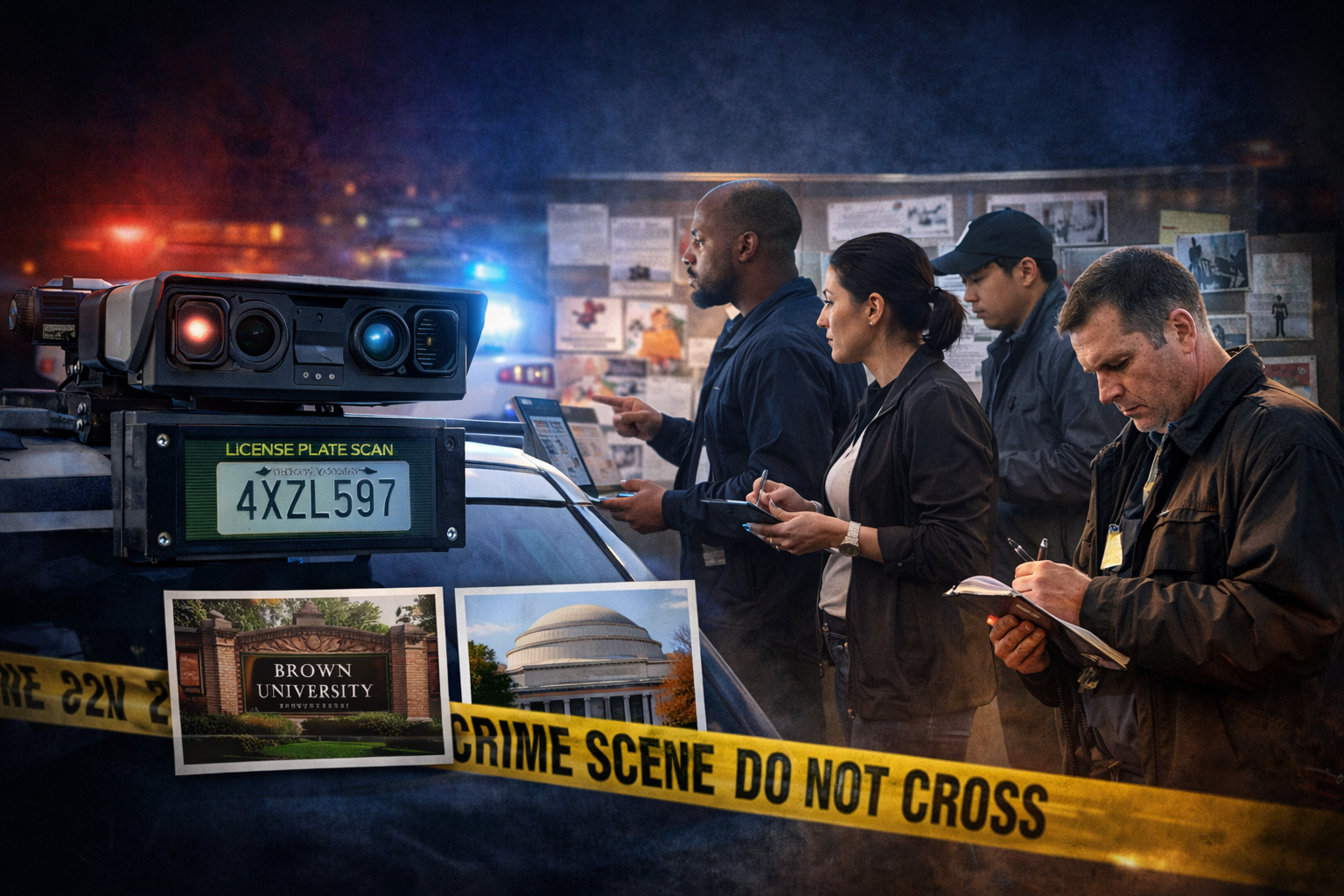
The recent use of License Plate Reader (LPR) technology in the Brown University and MIT
homicide investigations has triggered predictable outrage despite generating a lead that helped
bring a case to a conclusion. The claim, once again, is that LPR represents some novel invasion
of privacy. It does not.
Courts have been clear for years that license plates visible in public carry no reasonable
expectation of privacy. Appellate courts have ruled in favor of LPR technology nine times. The
Supreme Court has never taken the issue because there has been nothing new to decide.
This question has already been asked and answered.
What gets conveniently ignored is how investigations actually work.
Police detectives, agents, and analysts solve cases. They follow leads, test theories, eliminate
noise, and build facts piece by piece. Technology does not solve cases. It generates
information. People do the work.
LPR is a lead generator. That is it.
In the Brown and MIT cases and thousands more, LPR does not identify a suspect, assign guilt,
or make an arrest. It produced data points that investigators evaluated alongside witness
interviews, timelines, physical evidence, and other investigative tools that have existed for
decades.
A senior law enforcement leader recently argued that police have failed in educating the public
on how this technology works. That criticism deserves to be taken seriously.
But it is only half right.
Law enforcement does educate. From 2012 to 2018 I repeatedly visited Capitol Hill to brief
legislators on how LPR technology actually works, where its limits are, and how courts have
consistently ruled on its use. In every instance, poorly drafted legislation that would have
undercut investigations and public safety was challenged, corrected, or shut down because it
conflicted with established law.
Agencies regularly explain the legal framework, the guardrails, the oversight, and the case law.
The problem is not a lack of explanation. The problem is that certain critics disappear once the
law is settled, only to reappear a few years later recycling the same arguments and presenting
them as new concerns.
These are not serious privacy advocates. They are professional alarmists. Their business model
depends on outrage, not accuracy. When one issue stops raising money, they move on. When
donations dip, they return to the same well.
If they truly cared about privacy, they would educate themselves, follow the Constitution, and
acknowledge what courts have already decided instead of pretending precedent does not exist.
There is exactly one unresolved issue in this space.
That issue is whether the long-term aggregation of lawful LPR data could, over time, raise a
new constitutional question. That theory has not been tested. It has not been adopted by any
court. It remains hypothetical.
And even if that challenge comes, it will not change the basic reality.
LPR data alone cannot identify who was driving a vehicle. It cannot prove who was inside. It
cannot establish intent. It cannot put a person behind the wheel. Public movement remains
public.
LPR does not invade privacy. It documents what anyone standing on a street corner could
already see.
This is not unchecked surveillance. It is lawful policing using constitutional tools under judicial
oversight.
Once again, there is nothing new here.
And nothing improper.
Nothing to see. Nothing to do. Except keep doing exceptional police work.
Tom Joyce is a retired NYPD Lieutenant. He is co-host of Ten-Four Tavern on The
Finest Unfiltered Network